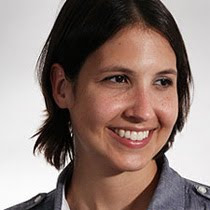
I went up to Johns Hopkins on Wednesday for a hearing test and to meet with Dr. C. On the cab ride over, I had a strange feeling, like I was returning to the scene of the crime. First I had a hearing test, and the results were not surprising: I am completely deaf in my left ear, but I have perfect hearing in my right. Even though that's what I expected to find out, it was still a little sad to get that news. I had another strange feeling when the audiologist was testing the left ear and I literally could not hear anything. She would say, "OK, listen for the beeps," and I would sit there in anticipation until the test was over, having not pushed the button once.
Then I went to my appointment with Dr. C. One of his residents came in first to talk to me about things. We discussed the BAHA, and I agreed to do the demo, even though I'm not really interested in getting it at this time. During the demo, a headband with the processor mounted on one side is placed on your head, so the BAHA processor can pick up sounds and transfer them through bone conduction. It's not as good as having the real thing (the post screwed into your head), but the results are interesting, nonetheless. The resident and I walked and talked for a few paces, with him being on my left side. I could hear him pretty well, so it definitely works.
Dr. C came in later and we talked about the BAHA a little more. He said that some people get along fine without it, and for some people, it makes a world of difference. I told him that I've been getting along fine without it so far, that there's maybe one incident per week where I get frustrated that I can't hear on that side, but that I seem to have adapted pretty well overall. It hasn't stopped me from going to work, going out to dinner in restaurants, or attending happy hours where I don't know anyone. So for me, I think it makes sense to wait until I really feel like I need it, and maybe there will be even better technology at that point. No sense in getting a post permanently screwed into my head if I don't really need one. Plus, getting a BAHA would make me one step closer to being completely bionic (I already have the insulin pump), and that's no good!
Then he checked my balance by doing the thing where I look at the tip of his nose and he turns my head back and forth quickly to see how well my eyes stay focused. After many head whips (not really sure what to call them) to test the knowledge of the resident and scare the medical student who was in the room, Dr. C declared that my right side has completely compensated for the loss of the vestibular nerve on the left side, and I was dizzy. It went away pretty quickly though. He also asked me to raise my eyebrows, shut my eyes tight, smile wide, and whistle. I passed this test with flying colors.
The next thing I have to look forward to in my "adventures with manny" is an MRI next February or March. Then I will meet with Dr. T to go over the results of that test, and Dr. C would like to see me again as well.
I am very thankful that things have turned out so well. Except for a couple of days after discontinuing the steroid, I have had no facial weakness. My balance is excellent. I have been able to adjust to single-sided hearing. No headaches, no pain. And my tumor is gone. I wish that everyone could be so lucky.
Showing posts with label Hopkins. Show all posts
Showing posts with label Hopkins. Show all posts
Thursday, September 24, 2009

Friday, April 10, 2009
Vestibular study results
 The researcher from the study got in touch with me this week to go over the results. Basically, he confirmed what I already knew: that my eyes move with my head when it turns to the left, and although the right side is better, it also has some deficiencies. His recommendation is to see a vestibular therapist for a couple of sessions to get some eye exercises that will help retrain my eyes and brain.
I told him I've noticed that since I've been getting out and doing more activities (running, walking, step aerobics), my bouncy vision and overall stability has seemed to improve. He thought that was a good sign that it may be able to fix itself over time without the help of a vestibular therapist but that I may still benefit from a session or two.
I think I'm going to wait another month to see what happens and how much I can do on my own, and then decide about the vestibular therapy. Hopefully the weather will start being more consistently warm so I can get out and about more frequently. I ran outside a second time this past weekend, and the "drunkenness" of my eyeballs was much less severe than the first run a week earlier. I think that's a good sign :)
(He sent me a page with graphs that show my "canal plane responses," and I have no idea what they mean, but I thought they looked cool. Also, he said that I am welcome to participate in additional testing with the wired contact lenses, but that I am under no obligation to do so. I might do it again, we'll see.)
Wednesday, March 25, 2009
Wired eyeballs
 You may have noticed that I didn't mention the study in my last post about my doctor visits. That's because it deserves a post all its own.
I was told that I would be participating in a study about eye movement and tracking, and that because I had lost my vestibular nerve on one side, it would be helpful to see how my eyes and brain had adapted so far. I would have to wear contact lenses with sensors around the outside of them that would monitor my eye movement while my head turned from side to side. I said, "OK, sounds doable."
When we walked into the lab with that crazy contraption, I thought, "What in the world did I sign up for???"
Well, I signed up to particpate in a study called "VOR adaptation and the use of saccades as rehabilitation strategies;" a quick Google search reveals that VOR stands for vestibulocular reflex and that saccades are fast movements of the eye.
The consent form explains that "this research is being done to better understand how the vestibular part of the inner ear plays a part in vision and balance. The vestibular part of the inner ear senses your head tilt and rotation during movements like walking or driving. It sends information to the reflexes that help keep your eyes looking straight ahead while you are moving. When the system fails, abnormal reflexes can cause dizziness and blurred vision."
Yep, that's what's been happening to me since the surgery - quick movements of my head make me a little unsteady and cause my vision to bounce around a bit. Sounds like it's going to be hard to do well on these tests...
After everything was thoroughly explained to me by the lead researcher and I signed the consent forms, we got started. I sat in the chair, which Phil and I later found out was built in 1960 and is one of about ten in the world, and proceeded to have contact lenses positioned on my eyeballs. They weren't for vision though - the center was open, and a very fine wire around the perimeter of the lens connected to a recording system that measured magnetic fields in the room.
Additionally, I was fitted with a bite block made of dental putty so that my head movement could be measured with another sensor inside the block. If you refer to the photo above, you will see a large metal frame surrounding the chair. This is where the magnetic field originates from, and the most concentrated point of magnetic activity is focused around the head area (it was a very weak magnetic field and did not require me to remove my insulin pump).
We began the Dynamic Visual Acuity testing. This consisted of me sitting in the chair with the lenses and bite block in place, looking at a computer screen several feet in front of me. First we did the test while my head was stationary; what I needed to do was identify the way a letter E was facing (up, down, left, right) at a variety of sizes from large (~2 inches) to small (~1/2 inch). This was not difficult when I wasn't moving.
The lead researcher stood behind me, placed another sensor band around my head, and then started the motion part of the test. He quickly moved my head with his hands, which activated the letter E to appear on the screen. My job was to again identify the way it was facing - the problem was that unless the E was at its largest size, it just looked like a blur to me. This is because the vestibular function of my left ear has been disabled, and my brain has not been fully trained to compensate yet. What happens is that when I look at a fixed object and my head turns rapidly, my eyes move along with my head for a split second until they re-fixate on the object. This is not how it is supposed to work; the eyes would remain fixated on the object no matter how fast the head is moving.
From what I could tell, I was better able to identify the position of the E when my head was turned to the right, which makes sense since my right-side vestibular function is intact. We repeated this test several times on each side to account for each direction that corresponds to a different semicircular canal in the eardrum. There was straight left-to-right, straight up-and-down, diagonal left-to-right, and the others for the right side as well. I asked Phil afterward if it was obvious which way the E was facing when I wasn't able to tell, and he said yes.
After the lead researcher reviews the results, he is going to send them to me so I can see where my deficiencies are. I have a feeling that I'm definitely going to want to see a vestibular therapist...I doubt ping pong is going to be a miracle cure.
 And, yes, it was awkward wearing the wired lenses. The right one got out of position halfway through and he took it out, so my left eye was doing all the work. Fortunately, I did not get a corneal abrasion from the testing, which was one of the risks, nor did I suffer a neck injury from all of the twisting. The photo at the left was taken while my eyes were being checked for scratches with fluorescent drops and a black light. If you look closely, you can see my eyes fluorescing...interesting, huh?
All in all, I think this was a worthwhile thing to do, and although they say in the consent form that there is no direct benefit to the participant, I think there just may be for me.
Tuesday, March 24, 2009
Q & A with surgeons
I had my six-week follow-up visits with my surgeons today. They were pretty quick, but I got my questions answered. I met first with Dr. C., the neuro-otolaryngologist (ENT).
Me: Is there any chance of my hearing coming back?
Dr. C: It's not likely, but we'll check your hearing at your next appointment once you've healed more fully. Then we can also talk about how you're doing and if you want to explore a bone-anchored hearing aid (BAHA).
(Note: This preempted my next question about another hearing test and the BAHA.)
Me: Do you guys do TransEar here, or just BAHA?
Dr. C: We don't really do TransEar. I'm learning more about it, but I doubt that it would work well enough to make it worth it. And I would be uneasy about recommending it for a person with diabetes - if you had an ear infection, it could transfer to the bone much quicker and be more of a problem for you.
(Note: The BAHA hearing device consists of a titanium rod that is surgically implanted into the bone behind the deaf ear. An external processor picks up the sound and the vibrations are transferred through the bone from the deaf side to the hearing side. The TransEar works similarly to this, except that the entire device is external; no additional surgery is required. A hearing aid, inserted far into the ear canal on the deaf side, picks up the sound and directs it toward the bone so the vibrations can be conducted to the hearing side.)
Me: I am still experiencing some eye jumpiness when I am moving quickly or turning my head quickly. Is there something I can do to help fix this, or is it more of a "give it time" thing?
Dr. C: Since you're now missing the vestibular function on one side, your brain has to be retrained to take over for it. There are a couple of things you can do. One would be to go to a vestibular therapist who can help you practice these movements in a controlled way that will help your brain learn how to respond. What happens to a lot of people is that they get into a rut and stop pushing themselves, so their brain doesn't get a chance to practice. If you perform activities that involve hand-eye coordination where you're also moving your head, it will help exercise your brain. So you could try ping pong, badminton, and tennis to gain back some of the vestibular function.
Then I ran down to the fifth floor to meet with Dr. T., the neurosurgeon.
Me: What exactly is in my head? Can you explain how it was put back together?
Dr. T: We drilled out the bone behind your ear to remove the tumor. Then we patched the hole in your skull with a titanium mesh plate. Above that is the muscle layer, and then your skin, so you shouldn't be able to feel anything strange under there. Let me take a look at your incision. [Dr. T looked at my incision.] It appears to be healing well.
(Note: This preempted my next question about how my incision looks.)
Me: What is the process for my hand returning to normal? I've noticed that it's not really numb anymore, and that it feels extra-sensitive. Is this a good sign?
Dr. T: Yes, generally when this happens, it goes from numb to hypersensitivity and then eventually back to normal. It is good that it is progressing.
Dr. T. said that he'll see me again in one year and that I'll get another MRI scan at that point. Dr. C. said he'd see me when I come to see Dr. T. again, but I don't think he expected that it would be in a year. I'm going to ask him if it would be good to come sooner than that; I'd like to get the hearing test in more like six months or so.
I guess the takeaway from my appointments is that I'm doing well and that my lingering issues are just that - lingering - and they'll need some more time to resolve themselves. I can help my brain learn to take over more of the vestibular function by becoming more active and purposely pushing myself to do more things, and I could enlist the help of a vestibular therapist as well. I'll see how I do with my single-sided deafness over the next few months before I decide if I want to explore a hearing device (my guess is that I'll be ok without one).
Me: Is there any chance of my hearing coming back?
Dr. C: It's not likely, but we'll check your hearing at your next appointment once you've healed more fully. Then we can also talk about how you're doing and if you want to explore a bone-anchored hearing aid (BAHA).
(Note: This preempted my next question about another hearing test and the BAHA.)
Me: Do you guys do TransEar here, or just BAHA?
Dr. C: We don't really do TransEar. I'm learning more about it, but I doubt that it would work well enough to make it worth it. And I would be uneasy about recommending it for a person with diabetes - if you had an ear infection, it could transfer to the bone much quicker and be more of a problem for you.
(Note: The BAHA hearing device consists of a titanium rod that is surgically implanted into the bone behind the deaf ear. An external processor picks up the sound and the vibrations are transferred through the bone from the deaf side to the hearing side. The TransEar works similarly to this, except that the entire device is external; no additional surgery is required. A hearing aid, inserted far into the ear canal on the deaf side, picks up the sound and directs it toward the bone so the vibrations can be conducted to the hearing side.)
Me: I am still experiencing some eye jumpiness when I am moving quickly or turning my head quickly. Is there something I can do to help fix this, or is it more of a "give it time" thing?
Dr. C: Since you're now missing the vestibular function on one side, your brain has to be retrained to take over for it. There are a couple of things you can do. One would be to go to a vestibular therapist who can help you practice these movements in a controlled way that will help your brain learn how to respond. What happens to a lot of people is that they get into a rut and stop pushing themselves, so their brain doesn't get a chance to practice. If you perform activities that involve hand-eye coordination where you're also moving your head, it will help exercise your brain. So you could try ping pong, badminton, and tennis to gain back some of the vestibular function.
Then I ran down to the fifth floor to meet with Dr. T., the neurosurgeon.
Me: What exactly is in my head? Can you explain how it was put back together?
Dr. T: We drilled out the bone behind your ear to remove the tumor. Then we patched the hole in your skull with a titanium mesh plate. Above that is the muscle layer, and then your skin, so you shouldn't be able to feel anything strange under there. Let me take a look at your incision. [Dr. T looked at my incision.] It appears to be healing well.
(Note: This preempted my next question about how my incision looks.)
Me: What is the process for my hand returning to normal? I've noticed that it's not really numb anymore, and that it feels extra-sensitive. Is this a good sign?
Dr. T: Yes, generally when this happens, it goes from numb to hypersensitivity and then eventually back to normal. It is good that it is progressing.
Dr. T. said that he'll see me again in one year and that I'll get another MRI scan at that point. Dr. C. said he'd see me when I come to see Dr. T. again, but I don't think he expected that it would be in a year. I'm going to ask him if it would be good to come sooner than that; I'd like to get the hearing test in more like six months or so.
I guess the takeaway from my appointments is that I'm doing well and that my lingering issues are just that - lingering - and they'll need some more time to resolve themselves. I can help my brain learn to take over more of the vestibular function by becoming more active and purposely pushing myself to do more things, and I could enlist the help of a vestibular therapist as well. I'll see how I do with my single-sided deafness over the next few months before I decide if I want to explore a hearing device (my guess is that I'll be ok without one).
Monday, January 26, 2009
Pre-op stuff
At my pre-operative appointment today, I did the following:
(In the interest of full disclosure, this post was actually written on 2/3/09.)
- Met with admissions and established that I am willing to pay $5 per day for a private room, if available
- Gave a thorough medical history to a nurse practitioner by answering "no" a lot
- Had an overall health exam by the NP and got dizzy from taking deep breaths repeatedly
- Allowed the Chinese resident doctor to look in my ear even though she couldn't hold the otoscope correctly
- Gave a urine specimen
- Maintained consciousness while my blood was drawn
- Had electrodes attached to me for an EKG test
- Signed surgical consent forms
(In the interest of full disclosure, this post was actually written on 2/3/09.)
Wednesday, December 17, 2008
Long day in Baltimore
Phil and I went up to Hopkins again today. Our first appointment was with Dr. T, the neurosurgeon. He had obviously done a lot of these surgeries as he had his whole conversation perfected. He briefly went through the treatment options and then discussed the retrosigmoid surgical procedure and its risks; Dr. T was able to give percentages specific to my case for my risk of hearing loss, facial paralysis, and headaches. Overall, Dr. T felt that I should make a pretty full recovery, and we felt good about Dr. T's knowledge and experience.
Afterward, I went to the audiology department to have an audiogram performed. I would get the results at my appointment later that day with Dr. C. Then I took part in a study that Dr. C was heading and went out to lunch with Phil and a friend from college. I was also able to speak with Dr. T's secretary to schedule the surgery for Feb. 9.
At the meeting with Dr. C, we went over some questions I had and the audiogram. It showed that I have a 30-40% loss of hearing in my left ear with 80% word recognition. This means that I can both hear reasonably well and understand speech very well. We all agreed that it would be in my best interest to try to save some of this hearing. Even if I end up with only a little hearing left, it will help with directionality and knowing where sound comes from. I signed the surgical consent forms, and then the appointment was done.
We went home feeling very good about things and looking forward to getting the surgery over with.
(In the interest of full disclosure, this post was actually written on 2/1/09.)
Afterward, I went to the audiology department to have an audiogram performed. I would get the results at my appointment later that day with Dr. C. Then I took part in a study that Dr. C was heading and went out to lunch with Phil and a friend from college. I was also able to speak with Dr. T's secretary to schedule the surgery for Feb. 9.
At the meeting with Dr. C, we went over some questions I had and the audiogram. It showed that I have a 30-40% loss of hearing in my left ear with 80% word recognition. This means that I can both hear reasonably well and understand speech very well. We all agreed that it would be in my best interest to try to save some of this hearing. Even if I end up with only a little hearing left, it will help with directionality and knowing where sound comes from. I signed the surgical consent forms, and then the appointment was done.
We went home feeling very good about things and looking forward to getting the surgery over with.
(In the interest of full disclosure, this post was actually written on 2/1/09.)
Tuesday, November 25, 2008
Baltimore, here I come
Phil and I went up to Johns Hopkins for the first time today. Dr. C, a neuro-otolaryngologist I found through a search on the discussion forum, was willing to see me on his off-day, only a few days after I initially called to make an appointment.
Our first impression was that even though the hospital isn't in the greatest part of town, the facility itself seems really good. The security at the entrances is reassuring, and the staff is very friendly and helpful. After we headed up to the appropriate floor, we found that the patient intake system is organized with a numbered ticket dispenser, which allows for patient confidentiality as well as creates confidence among the patients that they aren't being forgotten.
The appointment with Dr. C went well. We met first with a younger resident-type guy who took my history and cleaned a glob of wax out of my left ear. Then Dr. C came in and went over the treatment options (watch & wait, surgery, and radiation), focusing on the retrosigmoid surgical procedure. He said that, at Hopkins, they're excellent at retrosigmoid, good at translab, and they don't do middle fossa, and he talked to us about what to expect post-surgery in terms of headaches, loss of balance, and general recovery.
Dr. C also did a thorough examination of my current state of balance by asking me to do some marching in place with my arms extended and my eyes closed, and he checked my vestibular function by turning my head quickly and seeing if my eyes were able to stay focused on his nose. I was able to pass these tests, meaning that my balance nerve was still working and that I may have a harder time after surgery since my other vestibular nerve hasn't done a lot of compensating already.
At the end of the appointment, Dr. C said that I should make an appointment with Dr. T, the neurosurgeon, and schedule a new audiogram. He also gave me the surgical consent forms to look over and bring back next time I saw him if I wanted to have surgery there.
Overall, our impressions of Johns Hopkins and Dr. C were extremely positive, and we left there smiling and feeling very confident that these doctors would take good care of me.
(In the interest of full disclosure, this post was actually written on 1/30/09.)
Our first impression was that even though the hospital isn't in the greatest part of town, the facility itself seems really good. The security at the entrances is reassuring, and the staff is very friendly and helpful. After we headed up to the appropriate floor, we found that the patient intake system is organized with a numbered ticket dispenser, which allows for patient confidentiality as well as creates confidence among the patients that they aren't being forgotten.
The appointment with Dr. C went well. We met first with a younger resident-type guy who took my history and cleaned a glob of wax out of my left ear. Then Dr. C came in and went over the treatment options (watch & wait, surgery, and radiation), focusing on the retrosigmoid surgical procedure. He said that, at Hopkins, they're excellent at retrosigmoid, good at translab, and they don't do middle fossa, and he talked to us about what to expect post-surgery in terms of headaches, loss of balance, and general recovery.
Dr. C also did a thorough examination of my current state of balance by asking me to do some marching in place with my arms extended and my eyes closed, and he checked my vestibular function by turning my head quickly and seeing if my eyes were able to stay focused on his nose. I was able to pass these tests, meaning that my balance nerve was still working and that I may have a harder time after surgery since my other vestibular nerve hasn't done a lot of compensating already.
At the end of the appointment, Dr. C said that I should make an appointment with Dr. T, the neurosurgeon, and schedule a new audiogram. He also gave me the surgical consent forms to look over and bring back next time I saw him if I wanted to have surgery there.
Overall, our impressions of Johns Hopkins and Dr. C were extremely positive, and we left there smiling and feeling very confident that these doctors would take good care of me.
(In the interest of full disclosure, this post was actually written on 1/30/09.)
Subscribe to:
Posts (Atom)